Quanyan Zhu

Quanyan Zhu

Associate Professor, Department of Electrical and Computer Engineering
New York University Tandon School of Engineering

I study how strategic agents (people, machines, and now AI agents) make decisions, compete, and cooperate, and how to design systems that stay secure and resilient when some of them are adversarial. My work combines game theory, control theory, and learning theory to address problems in cybersecurity, cyber-physical systems, and agentic AI.

Research

Agentic AI and LLM multi-agent systems

Game-theoretic foundations for coordination, competition, and incentives among AI agents; reliable agentic workflows; the economics of agents and tokens; insurance for agentic AI. See Agentic AI and AI Tokenomics.

Dynamic games and multi-agent learning

Strategic learning, conjectural and Berk–Nash equilibria, mechanism design, and coalition formation in large-scale socio-technical systems. See Game Theory.

Cyber resilience and deception

Defensive deception, moving target defense, automated penetration testing, and AI-enabled autonomous cyber defense. See Game Theory for Deception for a primer, an interactive honeypot game, and papers by theme.

Cognitive security and human factors

Human vulnerabilities, cognitive biases, and misinformation as attack surfaces, and system-scientific defenses that account for them. See Cognitive Security.

Cyber-physical-human systems

Secure and resilient control of critical infrastructure, IoT, robotics, 5G networks, and cyber manufacturing.

Risk, insurance, and supply chains

Cyber insurance, risk preference design, and IoT supply chain risk analysis and mitigation.

Books

New book manuscripts

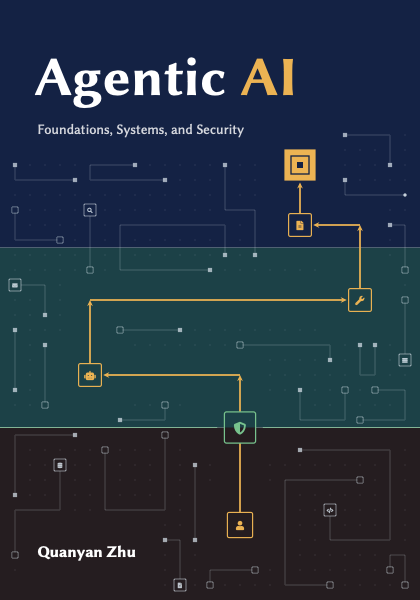
Cover of Agentic AI: Foundations, Systems, and Security
Agentic AI: Foundations, Systems, and Security Quanyan Zhu · manuscript, 2026

A graduate textbook on agents that plan, call tools, and act with delegated authority, built on decision theory, games, and learning. Three parts cover agents as decision-makers, building agentic systems, and security, resilience, and governance.

Sample: preface, full contents, and Part I (Chapters 1–3), 126 pages.

Sample chapters (PDF, 1.4 MB) Book website
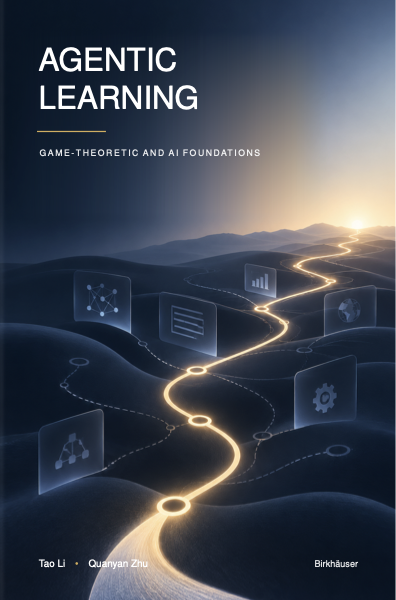
Cover of Agentic Learning: Game-Theoretic and AI Foundations
Agentic Learning: Game-Theoretic and AI Foundations Tao Li and Quanyan Zhu · Birkhäuser, forthcoming

How agents learn in strategic environments: behavioral, cognitive, and epistemic learning, from equilibrium and non-equilibrium dynamics to world models and conjectural learning. Fifteen chapters in five parts, about 570 pages.

Sample: contents, notation, and Chapters 1–3, 121 pages.

Sample chapters (PDF, 3.2 MB)
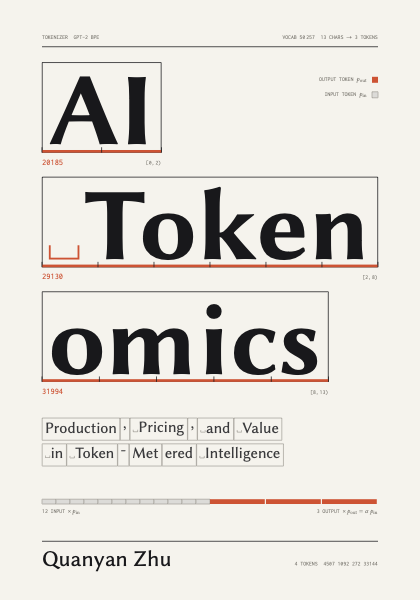
Cover of AI Tokenomics: Production, Pricing, and Value in Token-Metered Intelligence
AI Tokenomics: Production, Pricing, and Value in Token-Metered Intelligence Quanyan Zhu · manuscript, 2026

The economics of the token as the unit through which machine intelligence is produced, metered, priced, and governed. Twenty-one chapters and four appendices, about 710 pages.

Sample: preface, full contents, and Part I (Chapters 1–3), 103 pages.

Sample chapters (PDF, 1.2 MB) Book website
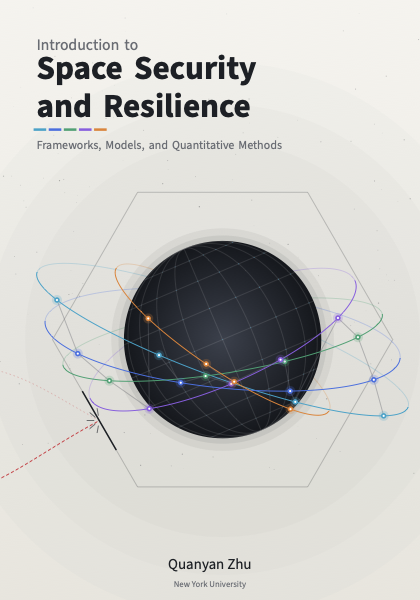
Cover of Introduction to Space Security and Resilience: Frameworks, Models, and Quantitative Methods
Introduction to Space Security and Resilience: Frameworks, Models, and Quantitative Methods Quanyan Zhu · manuscript, 2026

A quantitative treatment of space systems as contested critical infrastructure, spanning signal, link, and network security, physical threats and orbital games, cyber-physical security, and resilient architecture and governance. Twenty chapters in six parts and six appendices, about 1,080 pages.

Sample: front matter, full contents, and Part I (Chapters 1–4), 192 pages.

Sample chapters (PDF, 1.4 MB)
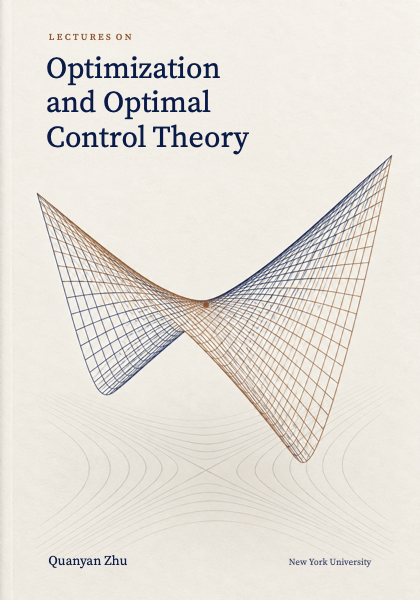
Cover of Lectures on Optimization and Optimal Control Theory
Lectures on Optimization and Optimal Control Theory Quanyan Zhu · lecture notes for ECE-GY 6233, 2026

A unified course from the mathematical foundations of optimization through convex optimization and algorithms to deterministic and stochastic optimal control, including the calculus of variations, estimation theory, and Kalman filtering. Fifteen chapters in five parts and two appendices.

Full manuscript, 789 pages.

Full book (PDF, 9.2 MB)
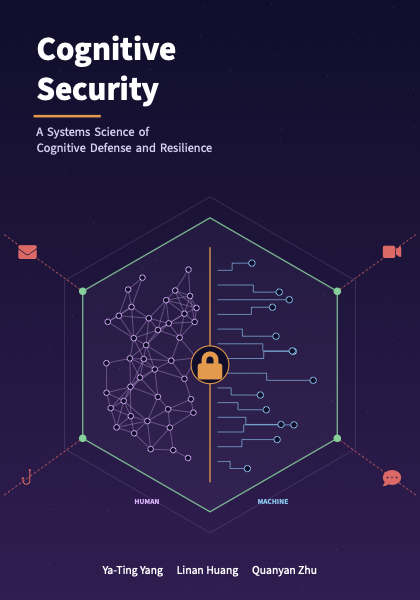
Cover of Cognitive Security: A Systems Science of Cognitive Defense and Resilience
Cognitive Security: A Systems Science of Cognitive Defense and Resilience Ya-Ting Yang, Linan Huang, and Quanyan Zhu · Springer, forthcoming

Human and machine cognition as a security frontier, moving past “the human is the weakest link” to vulnerabilities that can be modeled and engineered against: cognitive attack chains, defenses for individuals, organizations, and societies, deception turned to defensive advantage, and humans and AI in the control loop. Twenty-two chapters in seven parts with two appendices, about 810 pages.

Sample: preface, notation, full contents, and Part I (Chapters 1–4), 156 pages.

Sample chapters (PDF, 1.2 MB) Book website
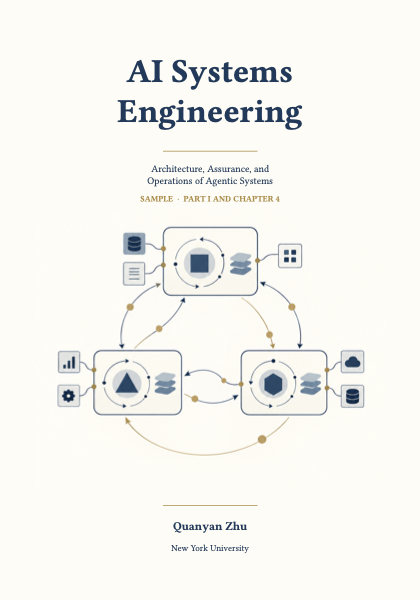
Cover of AI Systems Engineering: Architecture, Assurance, and Operations of Agentic Systems
AI Systems Engineering: Architecture, Assurance, and Operations of Agentic Systems Quanyan Zhu · manuscript, 2026 · course text for ECE-GY 5213

Systems engineering rewritten for components that behave stochastically: the five classical assumptions AI violates, architecture of agents and harnesses, an adapted lifecycle from concept through verification to sustainment, dependability and security, and the economics of running such systems. Sixteen chapters in six parts, about 400 pages.

Sample: contents, Part I (Chapters 1–3), and Chapter 4, 119 pages.

Sample chapters (PDF, 1.8 MB)
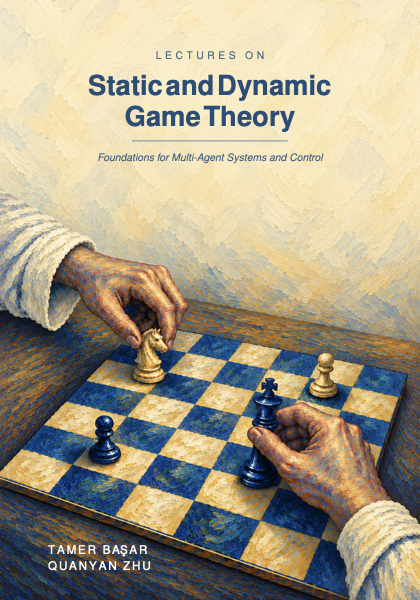
Cover of Lectures on Static and Dynamic Game Theory by Tamer Başar and Quanyan Zhu
Lectures on Static and Dynamic Game Theory: Foundations for Multi-Agent Systems and Control Tamer Başar and Quanyan Zhu · SIAM Press, to appear 2027

A graduate course from matrix games and Nash equilibrium through continuous-kernel and Stackelberg games, incomplete information, auctions and mechanism design, dynamic, repeated, Markov, differential, stochastic and mean-field games, to cooperative, matching, routing, evolutionary and learning games. Thirty chapters in seven parts with two appendices, about 950 pages.

Sample: Part I, Fundamentals of Game Theory (Chapters 1–8), 262 pages.

Sample chapters (PDF, 4.4 MB) Book website
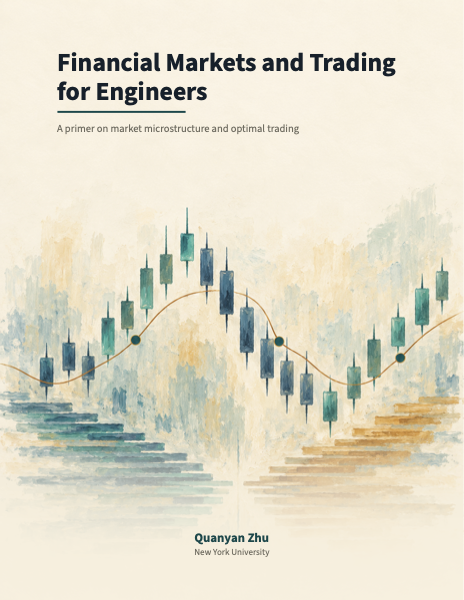
Cover of Financial Markets and Trading for Engineers
Financial Markets and Trading for Engineers Quanyan Zhu · lecture notes, 2026

A primer on market microstructure and optimal trading for readers who know stochastic control, convex analysis, and mathematical programming but not finance. A market is treated as a controlled dynamical system whose noise is endogenous, whose plant reacts to your control, and whose objective is a risk-adjusted terminal cash position: the limit order book, optimal execution, market making, hedging, portfolio selection, risk measures, backtesting, high-frequency and agentic trading. Sixteen chapters in three parts with appendices.

Full notes, 208 pages.

Read the notes (PDF, 3.9 MB)

Forthcoming

Game Theory for Security: With Applications to Cyber-Physical SystemsQ. Zhu, J. Chen, J. Farooq · Cambridge University Press, to appear 2027

Published (selected)

All books and edited volumes →

Selected recent papers

Agentic AI for Cyber Resilience: A New Security Paradigm and Its System-Theoretic Foundations
T. Li and Q. Zhu · arXiv:2512.22883, 2025
Revisiting Game-Theoretic Control in Socio-Technical Networks: Emerging Design Frameworks and Contemporary Applications
Q. Zhu and T. Başar · IEEE Control Systems Letters, 2025 · DOI
Adaptive Security Response Strategies Through Conjectural Online Learning
K. Hammar, T. Li, R. Stadler, Q. Zhu · IEEE Transactions on Information Forensics and Security, 2025 · DOI
Stackelberg Risk Preference Design
S. Liu and Q. Zhu · Mathematical Programming, 2025 · DOI
MEGA-PT: A Meta-game Framework for Agile Penetration Testing Best Paper
Y. Ge and Q. Zhu · GameSec 2024 · DOI
PenHeal: A Two-Stage LLM Framework for Automated Pentesting and Optimal Remediation Best Student Paper
J. Huang and Q. Zhu · AutonomousCyber Workshop, ACM CCS 2024 · DOI
On Poisoned Wardrop Equilibrium in Congestion Games Best Paper
Y. Pan and Q. Zhu · GameSec 2022 · DOI

Full publication list (searchable) →

Group

I am fortunate to work with outstanding students. Prospective Ph.D. students interested in game theory, agentic AI, and cyber resilience are welcome to get in touch.

Current postdoctoral researcher

Mohamed Arnouss
Fulbright Scholar

Past postdoctoral researcher

Song Fang
Oct. 2019 – Aug. 2021

Current visiting student

Takuma Adams
University of Melbourne, Australia

Alumni in faculty positions

Ya-Ting Yang (Ph.D. 2026)
Assistant Professor, National Taiwan University
Tao Li (Ph.D. 2024)
Assistant Professor, City University of Hong Kong
Shutian Liu (Ph.D. 2024)
Assistant Professor, City University of Hong Kong
Linan Huang (Ph.D. 2022)
Assistant Professor, Tsinghua University
Juntao Chen (Ph.D. 2020)
Associate Professor, Fordham University
Junaid Farooq (Ph.D. 2020)
Associate Professor, University of Michigan

Other Ph.D. alumni

Yunian Pan (2026), Yuhan Zhao (2024), Yunfei Ge (2024), Yinan Hu (2023), Tao Zhang (2023), Yunhan Huang (2022), Rui Zhang (2020), Jeff Pawlick (2018), Zhiheng Xu (2018).

Past visiting students

Anh Tung Nguyen (Summer 2026)
Uppsala University, Sweden
Yeongwoo Kim (Fall 2023)
KTH Royal Institute of Technology, Sweden
Kim Hammar (May 2023)
KTH Royal Institute of Technology, Sweden
Thi Thu Hang Nguyen (Summer 2017)
LAAS-CNRS, France
Liuwei Zhou (2015–2016)
Donghua University, Shanghai, China

Teaching

Courses developed

  • ECE-GY 6263 Game Theory (lecture notes sample)
  • ECE-GY 9223 Reinforcement Learning
  • ECE-GY 9233 Control and Optimization of Cyber-Physical Human Networks
  • ECE-GY 9253 System Foundations of Cyber-Physical System Security
  • VIP-UY 2001 Vertically Integrated Projects: Internet of Controlled Things

Regular courses

  • ECE-GY 6233 System Optimization Methods (lecture notes)
  • ECE-GY 8233 Optimal Control
  • ECE-UY 3064 Feedback Control
  • ECE-GY 5213 Introduction to System Engineering (course text sample)

Service

Contact

For research collaborations, speaking invitations, and inquiries about Ph.D., postdoctoral, or visiting positions, please get in touch by email.

Department of Electrical and Computer Engineering
New York University Tandon School of Engineering
370 Jay Street, Room 1004, Brooklyn, NY 11201, USA

Email: qz494@nyu.edu